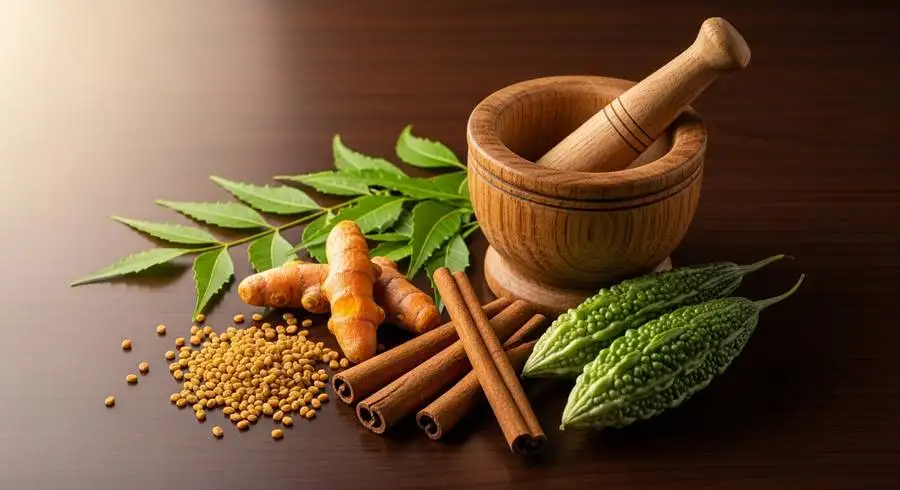
The Honest Starting Point
Ayurveda and Siddha medicine have prescribed specific herbs for 'madhumeha' (diabetes) for 3,000+ years. Modern pharmacology has validated some of them in rigorous clinical trials. Others haven't held up. This is a fair, evidence-based look at what traditional Indian medicine can and cannot do for diabetes in 2026.
What Has Solid RCT Evidence
1. Karela (Bitter Gourd) — Real effect, modest
Multiple RCTs in India have shown 100–200 ml of fresh karela juice daily drops fasting glucose 10–25 mg/dL and A1c 0.2–0.5% over 12 weeks. The active compounds (charantin, vicine, polypeptide-p) have insulin-mimetic effects.
Caveat: unpleasant taste, can cause GI upset, and the effect is modest (similar to one low-dose medication).
2. Methi (Fenugreek) — Well-validated
Soaked fenugreek seeds (10–25g/day) have consistently shown A1c drops of 0.3–0.6% in RCTs. Mechanism: soluble fibre slows carb absorption + trigonelline improves insulin signalling.
Practical: soak 1 tablespoon seeds overnight, drink water + chew seeds in morning. Works. Cheap. Effective.
3. Jamun (Indian Blackberry) — Seeds more than fruit
Jamun seed powder 2–3g/day shown in RCTs to drop fasting glucose 15–30 mg/dL. Fruit itself has limited effect. Seed powder is the evidence-based form.
4. Turmeric/Curcumin — Promising but absorbed poorly
Curcumin has anti-inflammatory effects and improves insulin sensitivity in trials. But bioavailability is poor — you need 500–1000 mg curcumin (not just turmeric powder) with black pepper and fat for absorption. Effect is modest: A1c drops 0.2–0.4% over 6 months.
5. Cinnamon — Specifically Ceylon, not Cassia
Real cinnamon (Cinnamomum verum, Ceylon) 1–3g/day has modest effect. Common 'cinnamon' in India is mostly Cassia, which contains coumarin that's liver-toxic at high doses. Ceylon is safer but less common. Effect: A1c drops 0.1–0.3% — smallest of the well-evidenced herbs.
6. Gudmar (Gymnema Sylvestre) — The 'sugar destroyer'
Classical Ayurvedic diabetes herb. RCT data from India (Jain et al) showed A1c drops 0.5–1.0% over 18 months at 400–600 mg/day of standardised extract. One of the most impressive herbs by effect size. Mechanism: temporarily blunts sweet taste, increases insulin output.
What Has Limited Evidence
- Neem: some animal studies, weak human trials. Not recommended for glucose specifically.
- Amla: antioxidant benefits, modest glucose effect
- Tulsi: mild glucose benefit, stronger stress/immunity benefit
- Guduchi (Tinospora): traditional use, limited modern data
- Shatavari: no glucose-specific evidence
Where Allopathy Wins Decisively
1. Acute crises
Diabetic ketoacidosis, severe hyperglycaemia, hypoglycaemic coma — these are medical emergencies. Insulin, IV fluids, emergency care. Ayurveda has no equivalent for these situations. Every year, preventable deaths happen because families try to manage a crisis with herbs.
2. Type 1 diabetes
Autoimmune beta-cell destruction. Insulin is mandatory. No herb can replace it.
3. Advanced diabetes with complications
Kidney disease, neuropathy, retinopathy — these require specialist care (nephrologist, podiatrist, ophthalmologist), specific medications (ACE inhibitors, SGLT-2s), and often procedures. Traditional medicine doesn't have equivalents.
4. Rapid A1c reduction
Starting from A1c 10%, modern drugs can get you to 7% within 3–6 months. Herbs alone cannot. If you're 10%, complications accumulate daily. This is a time-sensitive scenario that favours pharmacology.
5. Scale and standardisation
A metformin tablet contains exactly 500 mg. A karela preparation from your grandmother's neighbour varies 10×. Allopathy is standardised; herbal preparations often aren't.
Where Ayurveda/Siddha Genuinely Excel
1. Early prediabetes lifestyle intervention
The traditional framework emphasises diet, daily rhythm (dinacharya), seasonal adjustment (ritucharya), yoga, meditation. This holistic lifestyle intervention is exactly what prevents progression from prediabetes to diabetes — often better than any single medication.
2. Adjunctive support
Adding methi + jamun seed powder to metformin isn't fringe — it's commonly recommended by integrative endocrinologists in India. The combined effect is modestly greater than either alone.
3. Stress and digestion
Ayurveda's strong emphasis on stress, meal timing, and digestive fire (agni) captures concepts modern medicine is only now rediscovering. The chronobiology of eating matters enormously for glucose.
4. Psychological and spiritual framing
For many patients, the holistic frame of traditional medicine supports long-term adherence better than a transactional 'take this pill' approach. This is real even if unmeasurable.
The Drug-Herb Interactions That Matter
- Gudmar + sulfonylureas/insulin: hypoglycaemia risk. Coordinate with doctor.
- Karela + sulfonylureas: same
- Methi + warfarin: bleeding risk
- Turmeric (high dose) + blood thinners: bleeding risk
- Cinnamon (Cassia) + hepatotoxic drugs: liver strain at high doses
The Smart Integration
- Start with allopathic diagnosis and baseline (A1c, fasting glucose, ECG, kidney function)
- Follow evidence-based first-line medication if A1c >7 (usually metformin)
- Add evidence-backed traditional herbs (methi, karela, jamun) as adjuncts — tell your doctor
- Layer lifestyle from traditional frameworks: yoga, meditation, meal timing, dinacharya
- Monitor quarterly; adjust based on what works for your body
This is how most Indian endocrinologists actually practice — they just don't always tell patients it's a blend.
The JForH Approach
Our 365-day Diabetes Programme includes a dedicated Siddha/Ayurveda track curated by practitioners trained in both systems. Herbs are selected based on published evidence, dosages are standardised, and interactions with your prescribed medications are checked automatically. No fringe claims, no replacing critical medications — just the validated adjuncts, integrated properly.